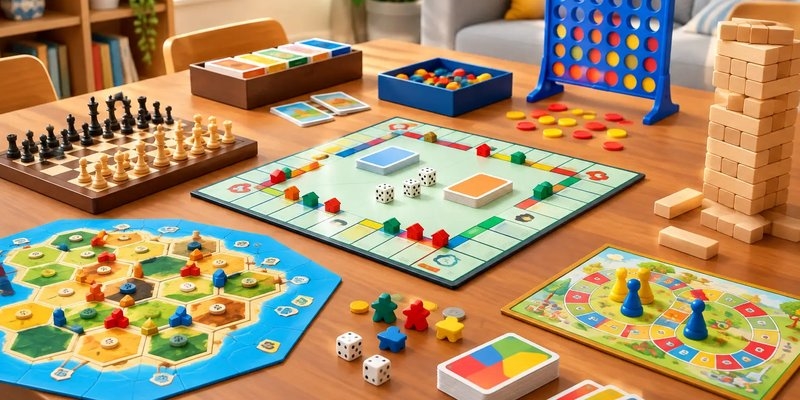
12 Best Family Board Games for Every Table
A great family game night should not begin with 20 minutes of rulebook decoding while the youngest player loses interest and someone asks when dessert is happening. The best family board games get people playing quickly, give every age group something meaningful to do, and leave room for the kind of friendly rivalry that has everyone asking for one more round.
The right choice depends less on the number printed on the box than on your table. A game that works brilliantly for two adults and an eight-year-old may fall flat with a large group of teens. Think about player count, reading level, playing time and, just as importantly, how your family handles competition. Some groups love direct attacks and dramatic comebacks. Others would rather build, collect and solve puzzles side by side.
What makes a board game work for families?
The strongest family games have a clear core turn: draw a card, place a tile, move a piece or choose from a small set of actions. That does not mean they are shallow. A good game gives younger players an obvious move while letting older players spot clever combinations, plan ahead or take a calculated risk.
Playing time matters too. For a weeknight, 15 to 30 minutes is often the sweet spot. Longer games earn their place on a rainy afternoon or holiday, provided everyone knows what they are signing up for. It also helps to have games that scale well from three players to five or six, rather than owning something that only works when the whole household is present.
Finally, consider the mood. Cooperative games put the table against the game itself, which can be ideal for families still learning how to win and lose graciously. Competitive games teach planning and resilience, but choose ones where a rough early turn does not leave a player sitting out or feeling beaten for an hour.
12 best family board games to put on the table
Ticket to Ride: First Journey
Ticket to Ride: First Journey is a smart starting point for children who are ready to move beyond roll-and-move games. Players collect coloured train cards and claim railway routes across a map, trying to complete simple ticket objectives. The turns are easy to explain, yet there is enough route blocking and map awareness to keep adults engaged.
It is particularly good for families with children around six and up. A full game is usually brisk, the components are inviting, and it introduces a classic modern board-game mechanism without overloading new players.
Kingdomino
Kingdomino makes tile placement feel immediately satisfying. Each player builds a five-by-five kingdom by matching terrain types, then scores larger connected areas with crowns. It takes minutes to teach, but choosing the right tile and turn order creates real decisions.
This is one of the best options when you want a game that feels calm rather than chaotic. It suits mixed ages because younger players can focus on matching fields, forests and lakes, while experienced players chase efficient scoring layouts. It also has a compact footprint, which is handy when the dining table still has dinner plates on it.
Sushi Go Party!
Technically a card game rather than a board game, Sushi Go Party! belongs in any family games collection. Everyone picks a card, passes their hand and reveals their chosen dish at the same time. You are collecting sets of sushi, desserts and side dishes for points, with each card type scoring in a different way.
The standard game is fast enough for younger players, while the Party! edition offers a large menu of card sets so you can adjust complexity between sessions. It works especially well for four or more players and keeps downtime close to zero.
Carcassonne
Carcassonne is a tile-laying classic that remains popular because the rules are so elegant. Draw a landscape tile, add it to the growing map, and decide whether to place one of your limited meeples on a road, city, monastery or field. When features are completed, you score points and retrieve meeples for later use.
Families who enjoy building something together will appreciate watching the countryside take shape. There is direct competition when players join or disrupt features, but it is rarely as confrontational as a take-that card game. The base game is more than enough for most households before considering expansions.
Rhino Hero Super Battle
For pure table-side excitement, Rhino Hero Super Battle is hard to beat. Players build a wobbly cardboard tower, move superhero figures upward and try not to bring the whole structure crashing down. There is light tactical play, but the main attraction is the physical challenge and the laughter when a carefully balanced wall finally topples.
It is a strong pick for younger families, school-holiday playdates and anyone who prefers a game that feels active. Set-up can take longer than the rules explanation, and it needs a reasonably steady table, but that is part of the event.
Azul
Azul has beautiful, chunky tiles and a deceptively simple drafting system. Players select coloured tiles from shared factory displays, then place them on a personal board to create scoring patterns. Take too many tiles at the wrong time and you lose points, so every choice has consequences.
The game is best for older children, teens and adults, generally from about eight years onward. It is not a game of luck alone, and that is its appeal: each round rewards planning without requiring a huge rules load. Families with competitive players may find it becomes a regular favourite very quickly.
King of Tokyo
If your household enjoys giant monsters, dice rolls and loud celebrations, King of Tokyo brings the energy. Players roll dice to attack rivals, heal themselves, gain energy or score victory points, then buy powerful upgrades that change what their monster can do.
There is player elimination, which is the main trade-off. In a close game it rarely causes a long wait, but a player who is knocked out early may be unhappy. It works best with families who enjoy dramatic swings and are comfortable with a little monster-on-monster mayhem.
Catan Junior
Catan Junior simplifies resource trading and settlement building for younger players. You sail between islands, collect resources and build pirate hideouts, aiming to expand before your opponents. It keeps the appealing rhythm of gaining resources and turning them into progress without the negotiation and complexity of standard Catan.
This is a good bridge game for children who are curious about bigger strategy titles. Parents should expect some luck from dice rolls, but players still make meaningful choices about what to build and where to expand.
Labyrinth
In Labyrinth, players slide rows of maze tiles to change the board, then move their pawn towards hidden treasures. The catch is that every move changes the routes available to everyone else. The rules are simple enough for primary-school players, but the puzzle of setting up a route while avoiding an easy path for the next player stays engaging.
It is a useful alternative to games based on reading, maths or fast reactions. The visual board tells players what is possible, helping children build spatial reasoning without feeling like they are doing homework.
Forbidden Island
Forbidden Island turns the whole family into a treasure-hunting team racing against a sinking island. Each player has a character ability, and together you must collect four treasures before key locations disappear beneath the water. The game creates genuine tension without needing a villain at the table.
Because players can openly discuss options, it is excellent for teaching planning and cooperation. More experienced adults can accidentally take over, though, so give younger players ownership of their character decisions. Raising the difficulty over time keeps the game useful once the basic strategy clicks.
5-Minute Dungeon
5-Minute Dungeon is quick, frantic and gloriously noisy. Players work together in real time, throwing down symbol-matching cards to defeat obstacles before the timer runs out. Each game really does move at speed, making it ideal when attention spans are short or you need a lively reset between longer activities.
The real-time format will not suit every family. Players who prefer to think quietly may find it stressful. For energetic groups, however, it is an easy way to get everyone involved at once.
Just One
Just One is a cooperative word-guessing game with an excellent party-game feel. One player tries to guess a mystery word while everyone else writes a single-word clue. Duplicate clues are removed before the guesser sees them, so the group has to be helpful without all thinking of the obvious answer.
It is best for confident readers and works beautifully with teens, parents and visiting relatives. The rules are almost instant to teach, and the surprises come from discovering which clues everyone independently chose.
How to build a family games shelf that gets played
Start with one fast game, one strategy game and one cooperative option. That small mix covers most evenings without filling the cupboard with boxes that only come out once. A quick title such as Sushi Go Party! or Just One gets a game night started, while Kingdomino, Carcassonne or Azul offers more thoughtful play when the group has time.
Do not buy solely by the recommended age on the box. Consider what your players already enjoy. A child who loves Pokémon may happily learn card effects and scoring patterns earlier than expected, while a child who dislikes reading may shine in Rhino Hero Super Battle or Labyrinth. Likewise, a teen who enjoys Warhammer or trading card games may be ready for deeper tactical choices than a traditional family title suggests.
At CardTastic, the best question is often not “What is the highest-rated game?” but “Who will be around your table?” Bring that answer to your next game choice. Pick something that matches your group tonight, make the rules clear, keep snacks away from the cards, and let the rematch become the reason everyone gathers again.