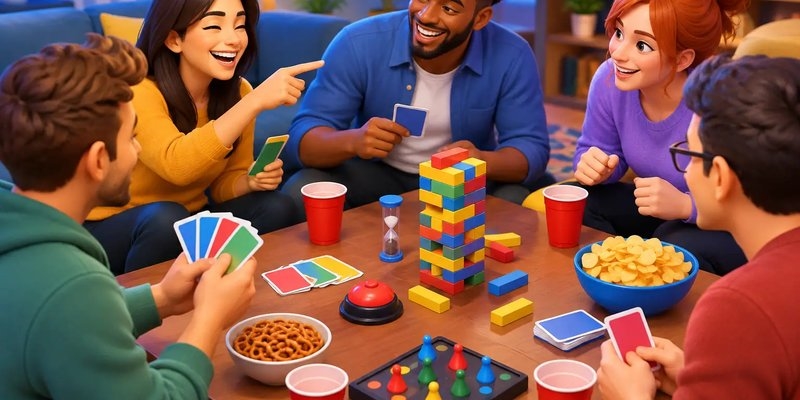
15 Best Party Games for Adults Worth Playing
A party game has one job: get everyone around the table involved before somebody starts scrolling on their mobile or quietly asks when dessert is happening. The best party games adults keep reaching for are easy to teach, give quieter players a way in, and create the sort of in-jokes that return at the next game night.
That does not always mean the loudest game wins. A group of competitive TCG players may love bluffing and deduction, while a mixed crowd of first-time players may have more fun with drawing, word association or a quick co-operative challenge. The right choice depends on your numbers, how well the group knows each other, and whether the room wants clever tension or absolute nonsense.
How to Choose the Best Party Games for Adults
Start with player count, not the artwork on the box. Some games technically play with three people but only truly shine at six or more. Others are ideal for four friends around a dining table, yet become slow and messy once a larger group joins in.
Think about the energy of the room too. Team word games such as Codenames reward discussion and big guesses. Social deduction games ask players to lie convincingly, which is brilliant for the right group and uncomfortable for people who dislike being put on the spot. If the gathering includes new players, choose a game with one simple action per turn and minimal scoring.
A good host also plans for the gap between games. Keep a 10 to 15-minute option ready while people arrive, eat or wait for the next round to begin. Then bring out the larger game once the table is settled. It is a small bit of organising that stops game night from losing momentum.
15 Best Party Games for Adults
Codenames
Codenames remains a standout for groups who enjoy language, lateral thinking and a little competitive pressure. Two teams race to identify their agents from a grid of words, guided by one-word clues from their spymasters. It plays best with six or more, but its simple rules let newcomers contribute immediately. The challenge is finding clues that are clever without being too clever.
Just One
Just One is a co-operative word game with a wonderfully generous feel. One player tries to guess a mystery word while everyone else writes a single-word clue. Matching clues are removed, so the table has to think differently without overcomplicating things. It is ideal when you want laughter and conversation without winners and losers taking centre stage.
Wavelength
Wavelength asks teams to place a clue somewhere between two opposite ideas, such as hot and cold, or serious and silly. Your team then debates where you meant on the hidden scale. That discussion is the game. It works especially well for mixed groups because a funny explanation can be just as satisfying as a perfect score.
Telestrations
Telestrations is the reliable answer when the group is happy to embrace terrible drawing. Each player alternates between writing a phrase and sketching what they think the previous player meant, creating a chain of increasingly chaotic misunderstandings. Artistic talent does not help much, which is exactly why it works. The final reveal routinely becomes the loudest part of the night.
Monikers
If your group enjoys pop culture references and fast rounds, Monikers is hard to beat. Players describe names or concepts to their team over three rounds, with the same cards becoming easier and funnier as everyone remembers the earlier clues. Expect broad references, quick improvisation and plenty of repeated catchphrases. It suits a group that already knows each other reasonably well.
The Chameleon
The Chameleon is a compact social deduction game for people who want suspicion without a two-hour commitment. Everyone knows the secret word except one player, who has to blend in as the others give careful clues. It is easy to teach and moves quickly, although it works best when players avoid making their clues either painfully obvious or impossibly vague.
Decrypto
Decrypto takes coded communication in a more strategic direction. Teams create clues for their own numbered words while trying to intercept the other side's code. It rewards pattern recognition, memory and teamwork, making it a strong choice for regular game groups rather than a crowd seeking pure chaos. Give new players a practice round, as the scoring can take a game to click.
Spyfall
In Spyfall, nearly everyone knows the shared location, from a casino to a submarine, while one spy tries to work it out through conversation. Players ask each other questions without giving away too much. The result is a compact bluffing game where a perfectly normal question can suddenly sound very suspicious. It is best with confident talkers and groups comfortable with improvisation.
Skull
Skull proves that a few coasters and a tiny ruleset can create real tension. Players place discs, raise the stakes, and decide whether to call another player's bluff. There is no trivia, no special knowledge and almost no downtime. It is an excellent warm-up for four to six players, especially for hobbyists who appreciate reading the table as much as reading the cards.
Coup
Coup is another fast bluffing classic, but with sharper consequences. Each player claims to have influential characters with powerful actions, whether those claims are true or not. Challenge the wrong person and you lose ground; let a lie stand and they may take over the table. It is compact, replayable and particularly strong with players who enjoy a bold move.
Love Letter
Love Letter is small enough to keep on hand for an impromptu game, yet its deduction is surprisingly satisfying. Players use a single card in hand, a single card played, and careful observation to remove rivals or hold the highest-ranked character. It is not a sprawling party game, but it fills the space between bigger games beautifully and accommodates a broad range of experience levels.
6 Nimmt!
6 Nimmt! is a numbers game that creates far more groans and cheers than its simple premise suggests. Everyone chooses a card simultaneously, trying to avoid completing rows and collecting penalty cards. There is enough probability to keep it unpredictable and enough calculation to reward attention. With up to 10 players, it is a brilliant choice for a larger table that wants everyone playing at once.
No Thanks!
No Thanks! turns a deck of numbered cards and a pile of chips into a deceptively sharp game of risk management. Take a bad card now, or pay a chip and hope somebody else takes it later? Rounds are quick, rules are learnt in minutes, and players naturally start reading one another. It is a strong option for a relaxed group that still likes tactical choices.
Blood on the Clocktower
For a big group ready to make an event of it, Blood on the Clocktower offers social deduction with a deeper structure than traditional hidden-role games. Dead players remain involved, every player receives useful information, and the storyteller can shape an unforgettable session. It needs a confident facilitator and a generous time slot, but for eight or more players it can become the whole evening.
Werewords
Werewords blends the familiar hidden-role format with a guessing game. One player secretly knows the answer, the werewolf tries to mislead the group, and everyone asks yes-or-no questions before time runs out. The app-supported structure keeps rounds moving, making it approachable for players who find more complex deduction games intimidating. It is particularly handy for groups of five to 10.
Match the Game to the Room
For a work social, family gathering or group of new acquaintances, start with Just One, Telestrations or Wavelength. These games create conversation without demanding performance or specialist knowledge. For a regular tabletop crew, Decrypto, Skull and Coup offer more room to develop tactics over repeated plays.
If your guests are arriving at different times, put Love Letter, No Thanks! or 6 Nimmt! on the table first. They are quick to explain and easy to reset. Save Blood on the Clocktower for a night where people have committed to staying, and nominate the storyteller before everyone gets comfortable.
The most memorable game nights are rarely about finding the objectively perfect box. They come from choosing a game that gives this particular group permission to be clever, ridiculous, suspicious or competitive together. Keep one easy opener, one main event and a spare deck-sized game ready, and your next table at CardTastic-level game night will have a reason to stay for one more round.