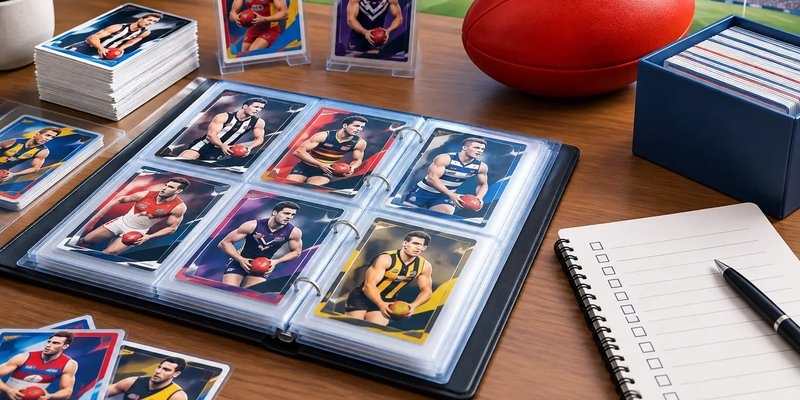
AFL Trading Cards Checklist for Collectors
A packet break can turn into a full collecting project quickly. One great club card becomes a favourite player chase, then a parallel, then a missing base card from the set you thought you had finished. A clear AFL trading cards checklist keeps the fun in the hunt while helping you spend deliberately, spot gaps and protect the cards that matter.
Whether you are building a team binder, chasing a signed legend, collecting your kid’s first season of footy cards or putting together a complete release, the best checklist is one that matches your goal. There is no single right way to collect AFL cards. There is, however, a much easier way to avoid duplicate piles, missed variants and avoidable condition damage.
Start Your AFL Trading Cards Checklist With a Goal
Before recording card numbers, decide what “complete” means for this collection. A master set collector may want every standard card plus inserts and all numbered parallels. A Western Bulldogs supporter might only want Bulldogs players across one release. A player collector may chase every card of one Brownlow Medallist, regardless of year or brand.
These approaches have very different costs and difficulty levels. A base set is usually achievable from sealed product, swaps and singles. Short-print inserts, low-numbered parallels, autographs and memorabilia cards can be much tougher to find, particularly for popular players and premiership-era stars.
Write your goal at the top of the checklist. Keep it specific: “Complete the 2025 base set”, “Collect every Brisbane Lions player card from this release”, or “One quality card from each club”. That single line makes buying decisions easier when you are looking at a new box, a trade table or a singles folder.
Record the Release Details First
AFL cards can look similar across years, but the set name, release year and card numbering are essential. Start each checklist with the product details, then list the cards beneath it. This avoids combining cards from different issues or accidentally ticking off a reprint as the original card.
Useful details to record include:
- release year and full set name
- card number and player name
- club shown on the card
- subset or insert name
- parallel colour, finish or serial number
- rarity and stated print run, where applicable
- condition and where the card came from
A card numbered 42 might be a standard base card in one set and a premium insert in another. Likewise, a silver parallel and a gold parallel may share the same player and card number but be separate cards for a master set. Treat every recognised variation as its own checklist entry if you intend to collect it.
For numbered cards, record the individual serial number too. “07/50” is not merely a rarity marker. Some collectors prefer jersey-numbered cards, first-numbered copies or matching serials, and accurate notes help if you ever trade or sell.
Separate Base Cards From the Premium Chase
A practical checklist has sections. Keep the base set in one section, inserts in another, and premium hits such as signatures, relic cards or low-numbered parallels in their own section. It is much more satisfying to see that you are 145 cards into a 180-card base set than to see one enormous list dominated by cards that may take years to locate.
This separation also makes budgeting realistic. Completing a base set may only require a handful of singles after opening a few packs. Completing every parallel can cost considerably more than the base set, and availability can be the limiting factor rather than price.
Check Card Condition Before You Tick It Off
For collectors, “owned” and “collection-ready” are not always the same thing. A card with a soft corner, a surface scratch or a noticeable print line may still fill a binder gap, but it should be marked honestly. That is especially true for numbered cards and signatures, where replacing a copy may not be simple.
Inspect cards under good light before adding them as a final tick. Look at corners, edges, centring, surface gloss and the back of the card. Chrome-style or dark-background cards can show surface marks more readily than matte stock. Foil cards may also have minor factory lines, so distinguish between damage and normal production variation where possible.
Use a simple condition note such as Near Mint, Excellent, Played or Damaged. If you collect with grading in mind, be more detailed: note centring, corner wear and surface flaws separately. Grading is not necessary for a great AFL collection, but it can make sense for scarce rookie cards, major stars, significant signatures or cards you intend to keep long term.
Do not clean cards with household products or tape a loose top loader shut against the card. A soft sleeve, followed by a rigid holder for higher-value cards, is the safer option.
Build a Checklist You Will Actually Update
Paper checklists are perfectly good for a binder set, especially for younger collectors and families sorting cards after a pack opening. For larger collections, a spreadsheet is more flexible. You can sort by club, player, card number, rarity, status and purchase price without rewriting anything.
A useful status column prevents confusion. Rather than only using a tick, use labels such as “need”, “ordered”, “owned”, “upgrade” and “for trade”. A card in the post should not send you searching for a second copy, while an “upgrade” label tells you that you own the card but would welcome a cleaner example.
Add a notes field for details that do not fit neatly elsewhere. You might record that a card is a duplicate, was pulled from a particular box, has a tiny print line, or is reserved for a mate at the next trade night. Those notes become surprisingly valuable once a collection grows past a few pages.
Track Spend, But Keep It in Perspective
A spend column is useful if you are trying to collect within a set budget. Record what you paid for packs, singles and postage where relevant. Over time, it shows whether chasing sealed product still makes sense or whether buying the remaining singles is the better move.
There is a trade-off here. Opening packs delivers the surprise, the chance of a big hit and a stack of trade material. Buying singles is usually more efficient when you only need particular cards. Many collectors enjoy a mix: open some product on release, then use the checklist to target missing cards later.
Avoid treating every card as an investment. AFL collecting is driven by player performance, club support, rookie interest, scarcity, card condition and collector demand, all of which can change. Buy the cards you will be happy to own even if their market value moves.
Store Cards According to Their Role
Your checklist should tell you where each card lives. Base cards for a completed set often suit a side-loading binder with archival-quality pages. Better inserts and parallels deserve penny sleeves and top loaders, while one-touch magnetic holders can suit display cards if the card fits correctly.
Keep collections away from direct sun, moisture and big temperature swings. Australian summers can be harsh on cardboard stock, particularly in sheds, cars and humid rooms. Store cards upright where possible, avoid overfilling binders, and do not stack heavy objects on top of boxed cards.
For a club collection, organise by season or player. For a complete set, numerical order makes missing cards immediately obvious. For premium cards, organise by player, rarity or personal importance. The best storage method is the one that lets you find a card without repeatedly handling every card around it.
Use Trading to Finish the Set
Duplicates are not rubbish. They are your best tool for finishing a base set and meeting other collectors. Keep tradable cards separate from your keeper binder, and list them on your checklist with condition notes. Being upfront about wear, bends or marks builds trust quickly.
When trading, compare rarity rather than just player name. A popular player base card is not automatically equal to a low-numbered parallel of a lesser-known player. That said, fair trading also depends on what each person actually wants. If both collectors leave happy, the trade has done its job.
At CardTastic, the appeal of trading cards has always extended beyond the pull itself. Sorting cards with friends, swapping duplicates and sharing a new signature hit are part of what makes the hobby stick. A checklist gives those moments a little more direction without turning them into homework.
Know When a Set Is Finished Enough
A checklist is meant to support your collecting, not turn it into a burden. If the last few cards are expensive, rare or simply no longer exciting, it is fine to call the collection complete at the level you chose. You can always create a separate want list for premium upgrades later.
Leave room at the bottom of every AFL trading cards checklist for unexpected finds: a childhood card rediscovered in a shoebox, a player who becomes your new favourite, or a bargain single that deserves a place in the binder. The best collection is not always the one with every box ticked. It is the one you will enjoy pulling out and showing someone after the final siren.