Choosing a Dungeons & Dragons Starter Set
The best first Dungeons & Dragons starter set is not the box with the most rules. It is the one that gets a group around a table, rolling dice and making questionable decisions before the snacks run out. For new players, the real challenge is not learning every spell or monster stat. It is getting enough structure to start playing without turning the first session into homework.
A starter set is built for that moment. It gives a Dungeon Master a ready-to-run adventure, gives players characters they can pick up quickly, and includes the odd-shaped dice that make D&D feel like D&D. Whether you are organising a family game night, bringing a board-game group into roleplaying, or finally answering the call of a mate who has been talking about dragons for years, choosing the right entry point makes a difference.
What a Dungeons & Dragons starter set actually does
Dungeons & Dragons is a collaborative fantasy roleplaying game. One person acts as the Dungeon Master, describing the world and playing its inhabitants, while the other players decide what their heroes attempt. The dice add uncertainty, but the story comes from the group.
A Dungeons & Dragons starter set strips away the initial barrier of the full game. Rather than asking everyone to build characters, choose equipment and understand dozens of rules before the first scene, it puts a playable adventure in the box. The Dungeon Master receives guidance on how to present encounters, adjudicate common actions and run monsters. Players receive pre-generated characters with names, abilities, backgrounds and reasons to get involved.
This matters because D&D is learned best while playing. A good first session starts with a problem that needs solving: a missing person, a creature in the caves, a strange signal from a ruined temple. Players say what they want to do, the Dungeon Master explains what happens, and the rules appear when they are useful. That rhythm is far less intimidating than reading a rulebook from cover to cover.
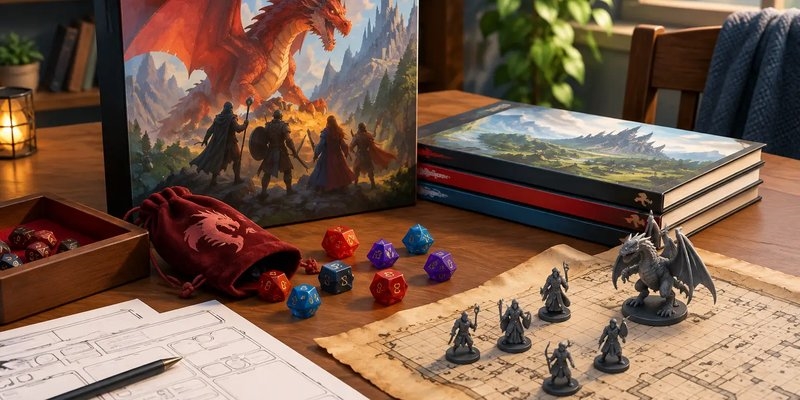
Most starter sets include a short rulebook, an introductory adventure, several ready-made character sheets and a set of polyhedral dice. Exact contents can vary by edition and printing, so check the product description if you are buying for a particular group. The important part is that one box contains the essentials for a Dungeon Master and a small party to begin.
Who should buy a Dungeons & Dragons starter set?
Starter sets suit absolute beginners especially well, but they are not only for beginners. Experienced Dungeon Masters often keep one handy for teaching new players, running a casual one-shot, or taking a compact game to a holiday house. Pre-generated characters reduce setup time and let a group discover whether roleplaying is their kind of hobby before investing in hardcovers, miniatures, paints or terrain.
They are particularly strong for groups with one confident organiser. That person does not need to be a theatre performer or a rules expert. They simply need to be willing to read a little ahead, describe what the characters see and make a call when the table is unsure. A calm “let’s roll and find out” is usually better than stopping the game to search for a perfect ruling.
For younger players, it depends on reading confidence, attention span and the tone the Dungeon Master chooses. D&D can be a fantastic family activity because it encourages problem-solving, teamwork and creative thinking. Keep sessions shorter, explain rules in plain language, and make sure every player has chances to contribute. Combat is only one way to solve a problem. Talking to a suspicious guard, sneaking past goblins or befriending a creature can be just as memorable.
A starter set may be less suitable if everyone in the group already knows they want to create highly customised characters from day one. In that case, the core rulebooks offer more options. Even then, a starter adventure can still be a useful first campaign framework.
Starter Set versus Essentials Kit
This is the comparison many new groups need to make. A traditional Starter Set is the more guided option. It generally provides pre-generated characters and an adventure written to teach the game as it goes. It is the easier choice for a group that wants to open the box and play with minimal preparation.
The Dungeons & Dragons Essentials Kit takes a slightly broader approach. It is often a better fit for a Dungeon Master who wants players to make their own characters early, use a larger range of quests, or run for one or two players with sidekick companions. It asks for a little more buy-in from the person running the game, but offers more flexibility once the group has its footing.
Neither is automatically better. Choose a Starter Set if speed, simplicity and a strong first-session experience are the priority. Choose an Essentials Kit if character creation and a more open adventure structure sound appealing. Plenty of groups start with one and move to the other later.
How to get the first session right
The Dungeon Master should read the adventure before the group arrives, but there is no need to memorise it. Focus on the opening situation, the first few locations and the personalities the characters are likely to meet. Put page markers on combat encounters and any rules you expect to use. That small bit of preparation keeps the game moving.
At the table, begin by setting expectations. Let players know whether the adventure will feel heroic, spooky, funny or a mix of everything. Ask them not to talk over each other, and remind them that player knowledge is not always character knowledge. Most importantly, make it clear that the goal is collaborative fun, not defeating the Dungeon Master or finding loopholes in every rule.
Give each player a moment in the spotlight early. The fighter might hold a doorway against a threat, the rogue could spot a hidden clue, and the wizard may recognise something strange about an ancient symbol. Players do not need to speak in accents or perform every line of dialogue. Some people enjoy acting in character; others prefer to say, “My cleric tries to persuade the guard.” Both approaches belong at the same table.
Keep the first session to a manageable length, usually two to three hours. Finish after a meaningful discovery, a tense encounter or a decision that leaves the party wanting to return. Ending slightly early is better than pushing on until everyone is tired and the story loses momentum.
Do you need miniatures, maps and extra books?
No. A starter set, pencils, paper and a table are enough. Coins, spare dice or small tokens can stand in for heroes and monsters if you want a visual aid. A hand-drawn map on grid paper is more than adequate for a first combat.
That said, the hobby grows beautifully when a group wants more. Miniatures make battles easier to visualise, dice sets give each player their own tools, and a battle mat can make positioning clearer. Terrain, painted figures and themed accessories add atmosphere, but they are enhancements rather than requirements. Do not let a social media game table convince you that a brilliant campaign needs a display-case budget.
The same applies to rules. The starter material is enough until the group begins asking bigger questions: Can we make our own heroes? What happens after this adventure? Can my character learn a new spell? That is the right time to look at the current core books, an Essentials Kit or a campaign book suited to the group’s preferred style.
Building a group that wants to come back
The sessions people remember are rarely the ones where every rule was applied perfectly. They are the ones where a player made an unexpected plan, a terrible die roll became a running joke, or the party chose kindness when a fight would have been easier.
For a new Dungeon Master, listen closely when the table gets animated. If everyone is fascinated by a shopkeeper, a pet creature or an odd clue that seemed minor in the adventure, give it room to grow. The written adventure is a useful guide, not a railway track. If players choose a sensible direction you did not expect, let their choices matter.
Once the first adventure ends, ask the group what they enjoyed most. More tactical combat, more mysteries, more character drama, or simply more dragons? That answer points to the next box, book, miniature or game night. CardTastic’s roleplaying range can help fill those gaps, but the most useful purchase is always the one your table is genuinely excited to use.
Start with the box that gets your group playing this week. A handful of dice, a shared story and permission to make a mess of the plan are enough to turn a quiet evening into the beginning of a campaign.