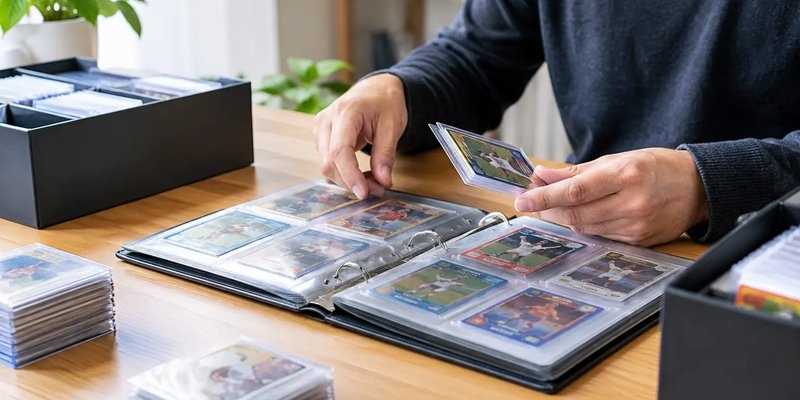
How to Organise Your Card Collection Properly
A card collection can go from one deck box on the desk to several thousand cards remarkably quickly. One week you are keeping a few Pokémon pulls, the next you are hunting a specific Magic: The Gathering rare before Friday Night Magic and wondering where all the bulk came from. Learning how to organise a card collection is not about making every card look museum-ready. It is about protecting condition, finding what you own, building decks faster and knowing what is worth keeping close.
The best system is the one you will actually maintain. A competitive player, a sealed collector and a parent sorting cards with their kids will each need a slightly different setup. Start with a simple structure, then add detail only where it saves you time.
Start by deciding what your collection needs to do
Before buying binders or shifting cards into a dozen labelled boxes, decide the job your collection needs to perform. If you regularly build Commander decks, you need cards to be easy to retrieve by colour, identity and format. If you collect Pokémon master sets, set number and binder order matter more. Sports card collectors may want to separate rookies, inserts, parallels and graded cards, while a trader may prioritise a compact trade binder that is easy to update.
Most collections work well when divided into four broad groups: cards for decks, cards kept for collecting or value, cards available for trade or sale, and bulk. This first separation does more work than an overly complicated filing system. It also stops a valuable alternate-art card being shuffled back into a box of common draft leftovers.
Keep active decks separate from the main collection. Deck boxes are made for transport and play, not long-term sorting. Label each one with the deck name, format or game. A small note inside the box can be handy for tracking swaps between versions of the same deck.
Protect cards before you organise them
Organisation is only useful if the cards stay in the condition you expect. Dirt, moisture, sunlight and loose storage can cause more grief than any imperfect sorting method. Use clean, dry hands and clear a proper workspace before handling higher-value cards. Food, drinks and open windows are not great companions for a binder session.
For valuable, foil, signed or sentimental cards, use a sleeve first. A soft inner sleeve can add protection for cards destined for a rigid holder, while a quality outer sleeve suits cards that will be played. Toploaders and semi-rigid holders are useful for cards you want to protect individually, but they take up more room than a binder and are less convenient for browsing.
Binders are excellent for display collections, trade cards and complete sets. Choose side-loading pockets where possible, particularly for higher-value cards, and avoid overfilling pages. Ring binders can be flexible, but cards near the rings can be vulnerable if pages are compressed or turned roughly. Fixed-page binders are often the simpler long-term choice for prized collections.
For bulk, use card storage boxes with dividers rather than loose stacks in a drawer. Store everything upright with enough support that cards do not bow, but not so tightly that edges rub when you pull them out. Keep boxes off the floor and away from direct sun, garages with big temperature swings and damp cupboards.
Build a sorting system you can repeat
There is no single best way to organise trading cards. The right order depends on the game and your reason for collecting. What matters is choosing categories that are obvious at a glance and applying them consistently.
For games such as Magic: The Gathering, a useful bulk system might begin with colour, then card type or mana value, followed by set if you need it. Multicolour, colourless, lands and tokens deserve their own dividers. Players who mostly build casual decks may prefer to sort by colour and creature type, especially if they often look for Dragons, Elves or Zombies.
Pokémon collectors commonly start with era or expansion, then place cards in numerical set order. Reverse holos, secret rares, promotional cards and duplicate copies can be separated so a master set remains easy to check. For Yu-Gi-Oh!, One Piece, Disney Lorcana, Digimon and Flesh & Blood, sorting by set is usually helpful for collectors, while rarity, colour or class may be more useful for active deck builders.
Sports cards often need a different approach. Sort first by sport and year, then by brand or set. Within that group, keep base cards apart from inserts, numbered parallels, autographs, memorabilia cards and rookie cards. This makes it far easier to assess what you have when you are completing a set, preparing a trade or checking a card's condition and market interest.
Do not feel obliged to sort every common card down to an individual set number. For a large bulk collection, that is a major time investment with limited payoff unless you sell singles or build extensively from it. A well-labelled box of blue Magic commons is often more practical than fifty perfectly ordered mini-stacks you are afraid to disturb.
Use labels that answer one question
A label should tell you where a card belongs without opening the box. “Pokémon - Scarlet & Violet - duplicates” is useful. “Cards 3” is not. Write labels clearly and place them on the front and top of storage boxes if they will be stacked.
Dividers are worth using whenever a box holds more than a few categories. You can use alphabetical tabs for a trade binder, colour-coded dividers for a deck-building box, or simple handwritten cards for bulk. The goal is speed, not presentation perfection.
Keep a catalogue for cards that matter
Physical organisation tells you where a card lives. A catalogue tells you what you own. You do not need to log every spare common, but tracking valuable singles, complete sets, graded cards and cards listed for trade can save duplicated purchases and frustrating searches.
A spreadsheet is enough for many collectors. Record the game, card name, set, collector number, rarity, condition, quantity, storage location and a rough purchase price or current value if relevant. Add a note for special details such as foil treatment, language, grading company or a signed copy. A location field such as “Binder A, page 12” or “Box MTG-Blue, divider 4” turns the catalogue into a genuinely useful tool.
Collection apps can be quicker for scanning and price checks, although catalogue data is not always perfect. Treat automatically generated prices as a guide rather than a guarantee. Condition, print version, local demand and whether a card is actually easy to sell all matter. If you trade regularly at events, keep your trade stock updated after each session so you do not offer cards that have already gone into a deck.
Make trading and deck building easier
Keep trade cards separate from personal collection cards. It avoids awkward moments when someone asks about a card you only brought because it was stored in the same binder. A trade binder should contain cards you are genuinely open to moving, with pricing and condition assessed honestly.
For deck building, maintain a clearly marked staples section. This may include Commander mana rocks and lands, Pokémon trainer cards, generic Yu-Gi-Oh! hand traps or other format staples. A small reference box for frequently used cards can dramatically cut down the time between choosing a deck idea and getting it onto the table.
If you attend organised play, make a habit of returning cards to their proper place after testing and trades. Five minutes after an event is easier than a three-hour rescue mission after a month of loose cards pile up in a backpack.
Schedule small collection resets
Collections change with every booster box, pre-order, trade night and deck update. Instead of waiting for chaos, set aside a short reset after a new release or once a month. Put cards back in their zones, update your catalogue, replace damaged sleeves and move anything you no longer want into your trade or sale pile.
CardTastic collectors often cross between games, so keep each game clearly separated even if they share a storage shelf. Similar card sizes do not mean similar sorting needs, and mixing collections makes both deck building and trading slower.
A good collection system should make you want to look through your cards more often. When you can find the card you need, see the progress in a set and bring a clean trade binder to game night, the collection feels less like clutter and more like part of the hobby.