How to Value Pokémon Cards Before You Trade
A card can look like a big pull straight from the pack, then turn out to be a few dollars once you check the set, version and condition. The reverse can happen too: an older common, a tournament promo or a misprinted card may be worth far more than its rarity symbol suggests. Learning how to value Pokémon cards means looking beyond the artwork and using evidence that reflects what collectors and players are actually paying.
For Australian collectors, that evidence also needs local context. Prices are usually discussed in Australian dollars, postage can shift the economics of lower-value cards, and a card’s value can differ between a quick cash sale, a store trade-in and a private sale. Here is a practical way to assess your cards before you buy, sell or trade.
Start by identifying the exact card
Pokémon has printed thousands of cards, often with the same character appearing in multiple sets, rarities, languages and finishes. A Charizard is not a value on its own. You need to identify the precise printing.
Check the card name, card number and set number at the bottom of the card, such as 199/165. Then note the expansion symbol or set name, release era, rarity, language and whether the card is holographic, reverse holo, full art, illustration rare, special illustration rare, ex, V, VMAX, GX or an older equivalent. First Edition stamps, promo stamps and staff stamps matter too.
Pay close attention to version. A regular holo and reverse holo from the same set can have different demand. Pre-release promos, league promos and stamped cards are frequently mistaken for standard printings. Even an energy card can be valuable if it is a scarce tournament or event version.
If you are unsure, compare every visible detail with a reliable card database or listings for the exact card number. Do not value a card from its character name alone.
How to value Pokémon cards with sold prices
The most useful starting point is recent completed sales for the same card in comparable condition. Asking prices are not proof of value. Anyone can list a $20 card for $200; it only becomes meaningful when someone pays that amount.
Look for several recent sold results rather than choosing the highest one. Remove obvious outliers, such as a heavily played copy sold cheaply in a job lot or a pristine graded copy that achieved a premium. A cluster of comparable sales gives you a realistic market range.
Use Australian-dollar sales where possible, especially for modern cards and cards likely to be traded locally. Overseas results can still be useful for scarce vintage cards, but factor in exchange rates, international postage, marketplace fees and the smaller buyer pool in Australia. A US sale price is not automatically an Australian cash value.
Timing matters. Fresh chase cards from a newly released Pokémon set can move sharply in the first few weeks. Competitive cards may rise after a major tournament result, then fall following rotation, reprints or a metagame shift. Vintage cards tend to be steadier, but condition and grading create wider price gaps.
Condition can change the price dramatically
Condition is one of the biggest variables in Pokémon card valuation. Two copies with the same card number may be worth very different amounts because collectors pay for clean surfaces, sharp corners and strong centring.
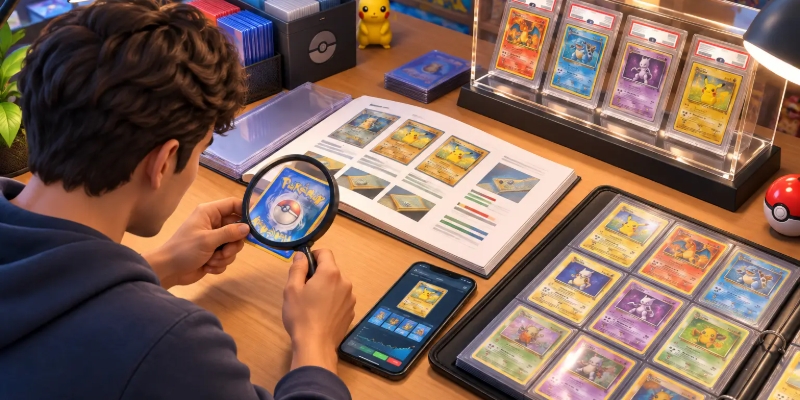
Assess the card under good natural or indirect light. Avoid sliding it across a table or handling it without a sleeve while inspecting it. Check the front and back for whitening, edge wear, dents, creases, scratches, print lines, pressure marks, stains and surface holo scratching. Look at the card from an angle, as dents and scratches can be nearly invisible head-on.
Most raw-card listings use condition bands such as Near Mint, Lightly Played, Moderately Played, Heavily Played and Damaged. These labels are useful, but they are not perfectly standardised. A Near Mint card should have very minor flaws at most. A tiny white speck may be acceptable to some buyers, while a dent, crease or significant whitening will usually push a card down a grade.
Be conservative when selling. Clear photos of the front, back, corners and any flaw protect both parties and make a smoother trade far more likely. For expensive cards, disclose even small defects. Condition-conscious collectors will spot them.
Understand rarity, demand and supply
Rarity affects value, but it does not decide it by itself. A high-rarity card with little collector appeal or no competitive use can remain affordable. A lower-rarity card can become expensive when it is hard to find, essential in a deck, features popular artwork or comes from an older set with fewer surviving copies.
Modern Pokémon values usually come from a mix of pull rates, character popularity, artwork and player demand. Special illustration rares and popular Pokémon often carry collector premiums, while playable Trainers, Pokémon ex and other staples can hold value because tournament players need multiple copies.
Vintage cards introduce another question: how many clean copies still exist? A common from a 1990s set may not be rare in an absolute sense, but a truly Near Mint copy can be difficult to locate. First Edition, shadowless, error and limited-distribution cards need especially careful identification because small print differences can be substantial.
A card’s popularity is also not permanent. The best valuation is a current market snapshot, not a promise of future growth.
Raw, graded and sealed are different markets
Do not use a graded-card sale to price a raw copy. A card graded 10 has been independently assessed, encapsulated and placed in a market where buyers expect a premium. That premium reflects condition, grading fees, turnaround time and confidence in the grade, not just the cardboard itself.
Likewise, a raw card that looks clean is not automatically a potential 10. Centring, tiny surface marks, factory print lines and edge imperfections can all affect the result. Grading makes most sense when the card is valuable enough to justify the cost and you have inspected it carefully. It can be worthwhile for standout vintage cards, major modern chase cards and personal collection pieces, but not every holo needs a slab.
Sealed products follow their own supply-and-demand cycle. A booster box, Elite Trainer Box or collection box is not valued by adding up its possible pulls. Print runs, reprints, set popularity and sealed collector demand are the main drivers.
Price for the type of transaction
The value you can receive depends on how you sell. A private sale generally delivers the highest return, but it takes time to photograph, list, pack, post and manage buyer questions. Marketplace fees and postage materials also reduce the final amount.
A trade or store buylist offers convenience, faster payment and less risk, but the offer will normally sit below private-sale value. A retailer has to inspect, hold inventory and resell the card at a sustainable margin. That is not a sign that the card is undervalued; it is a different service and transaction type.
When trading with another collector, agree on a fair reference point first. Use recent sales in similar condition, price both sides in the same currency and be honest about defects. Trades work best when both people understand whether they are using cash value, trade value or a slightly higher value for sought-after cards.
Watch for authenticity and altered cards
Before assigning a serious price, confirm that the card is genuine. Counterfeits are common around expensive chase cards, vintage holos and popular Pokémon. Warning signs include incorrect fonts, unusual colours, poor text clarity, a glossy plastic feel, incorrect holo patterns and card stock that feels too thin or too stiff.
Do not use destructive tests on a card you might own or sell. Instead, compare it with a known genuine card from the same era, inspect the print quality closely and seek an experienced opinion if the card is valuable. Altered cards, including recolours, added signatures and repaired creases, should also be described accurately. An alteration may have personal appeal, but it usually changes the collector market.
Keep a simple valuation record
For cards worth tracking, record the exact printing, condition, date checked, recent sale range and your source notes. This is handy for collection insurance, trades and deciding whether to grade a card. It also stops an old price memory from becoming the number you rely on months later.
Store valuable cards in a penny sleeve and a suitable top loader, semi-rigid holder or binder pocket as soon as possible. Good protection will not turn a played card into Near Mint, but it prevents avoidable wear while you decide what to do with it.
The best card valuation is a fair, well-supported range rather than one magic number. Take your time, inspect the details and use recent comparable sales. That approach gives you the confidence to enjoy the hunt, whether you are filling a binder, tuning a deck or bringing a trade folder to your next game night.