Pokémon ETB Review: Are Elite Trainer Boxes Worth It?
A fresh Pokémon Elite Trainer Box has a particular appeal: the set artwork is front and centre, the sleeves match, and everything needed for a proper game night fits in one sturdy box. But a Pokémon ETB review needs to look beyond that first unboxing moment. Elite Trainer Boxes are excellent products for some collectors and players, yet they are not automatically the best-value way to open packs from every new set.
For Australian Pokémon fans deciding between an ETB, Booster Bundle, Build & Battle Box, single boosters or a full Booster Box, the right choice comes down to what you want from the purchase. Are you building a deck, starting a collection, chasing a favourite Pokémon, or simply looking for a tidy place to store the cards you already own?
What is in a Pokémon Elite Trainer Box?
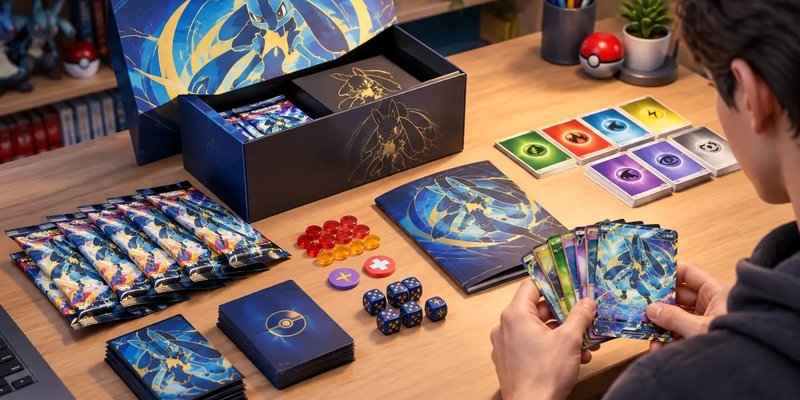
An Elite Trainer Box, usually shortened to ETB, is a premium sealed product built around a Pokémon TCG expansion. Standard ETBs from recent Scarlet & Violet sets generally include nine booster packs, a full-art promo card where applicable, a set of themed card sleeves, Energy cards, dice, condition markers, acrylic damage counters, dividers and a collector's box with a lid. A player's guide is also included, showing cards from the expansion and often highlighting key Pokémon, Trainer cards and rarities.
Contents vary between eras and products. Many Sword & Shield ETBs contained eight booster packs, while special sets may use a different pack count or include additional promos. Pokémon Center ETBs can also have exclusive variants, although availability and distribution differ in Australia. Always check the product description for the exact release rather than assuming every ETB has identical contents.
The outer box is more useful than it first appears. With the included dividers, it can hold a sizeable stack of sleeved cards, spare dice, deck components or bulk sorted by type and set. For players who attend League, casual games or prerelease events, having one box that keeps accessories together is genuinely handy.
Pokémon ETB review: where the value really sits
The boosters are the obvious part of an ETB's value, but they are only part of the equation. If you only want packs, divide the ETB price by the number of boosters and compare that figure with single booster prices, Booster Bundles and Booster Boxes. On pure pack cost, an ETB is often not the cheapest option. A Booster Box usually works out better for larger openings, while a Booster Bundle can be the sensible middle ground for collectors who want several packs without the accessories.
That does not make an ETB poor value. The sleeves, dice, dividers and storage box have a real replacement cost, particularly for a newer player who has none of those items. The sleeves are usually tournament-legal and look great with a deck from the matching expansion. They are not always the first choice for competitive players who prefer thicker, longer-lasting premium sleeves, but they are perfectly practical for kitchen-table games, League decks and a first 60-card build.
The promo card can also change the calculation. Some ETBs include an exclusive stamped or full-art promo that collectors specifically want. It may never pay for the entire product on its own, and values can move quickly after release, but it gives the box an identity beyond its random booster pulls.
The key trade-off is simple: an ETB gives you a complete set-themed experience, while a Booster Box or Booster Bundle focuses more heavily on pack volume. Neither is wrong. The better purchase depends on whether you will use the extras.
Who should buy an ETB?
ETBs are particularly well suited to newcomers returning to Pokémon TCG after a long break. Instead of buying packs and then realising you still need sleeves, Energy cards and damage counters, you begin with the basic gear to play. Add a League Battle Deck, a couple of singles to improve it, and you have a practical path into casual and organised play.
They also suit collectors who pick up one sealed product from each favourite expansion. The artwork changes set by set, so a row of ETBs makes an attractive, compact display. If you keep sealed product, protect the corners from dents, avoid stacking heavy items on top, and store boxes away from moisture and direct sunlight. Condition matters to sealed collectors just as it does for singles.
Families can get plenty from an ETB as well. The accessories reduce the scramble for counters and Energy, while the box helps keep cards off the dining table between games. The booster opening itself can be a fun shared activity, provided expectations are sensible. Booster packs are random, so no ETB guarantees a specific ex, illustration rare, Special Illustration Rare or gold card.
Competitive players are more selective. If your goal is to build the strongest version of a tournament deck, sealed packs are rarely the efficient route to specific cards. Buying singles is normally smarter. An ETB still makes sense if you want the promo, enjoy opening the set, need the accessories or like the sleeves, but it should not be mistaken for a deck-building shortcut.
ETB pulls: set expectations before opening
A common question is whether ETBs have better pulls than loose boosters. For standard Pokémon TCG products, there is no reliable reason to expect an ETB to have superior hit rates. Packs are designed around randomised distribution, not a guaranteed number of high-rarity cards per box. One ETB may produce several exciting pulls; another may be quieter despite containing the same number of packs.
That uncertainty is part of pack opening, but it is worth budgeting for it. Buy an ETB because you enjoy the product and its included items, not because you expect it to return its shelf price in cards. Most sealed openings will not. If a particular card is the goal, checking the singles market first can save a lot of disappointment and duplicate bulk.
For set collectors, an ETB can be a satisfying first step rather than the finish line. Open the packs, sort pulls immediately, sleeve anything valuable or playable, and use a binder with side-loading pockets for your collection. Keep reverse holos, rares and playable Trainers organised too. Cards that seem ordinary on release can become useful when a new deck or rotation changes demand.
ETB versus other Pokémon TCG products
A Booster Bundle is often the cleaner option if you want a modest number of packs without accessories. It is compact and can offer a lower cost per pack, especially when you already have sleeves and dice.
A Booster Box is aimed at bigger openings, group pack battles and collectors chasing a broad spread of a regular expansion. The upfront cost is higher, but the per-pack price is commonly lower than buying individual packs. It also produces plenty of duplicates, so it is best for people who trade, build multiple decks or do not mind sorting bulk.
Build & Battle Boxes are different again. They are designed around prerelease play, containing a ready-to-play Evolution pack and boosters to modify it. They are brilliant for experiencing a new set in a social environment, but they are not a substitute for an ETB's accessories or storage.
Collection boxes and tins tend to be promo-led purchases. If the featured Pokémon is the main draw, they can be excellent. Their pack selection may include different expansions, however, so they are less focused if you are collecting one particular set.
Buying the right ETB for your collection
Before choosing an ETB, check three details: the featured expansion, the included promo and the booster count. Then consider the artwork. This might sound cosmetic, but if the box will live on your shelf or carry your deck to events, choosing a design you genuinely like adds value that a quick price-per-pack calculation misses.
For a current expansion, pre-ordering can be useful when you know you want to open on release weekend or attend a prerelease. For older sets, compare the sealed price with the cards you still need. Once an ETB becomes hard to find, its collector premium can rise well beyond the practical value of its packs and accessories.
If you are unsure, a good rule is this: buy the ETB when you want the complete set experience, and choose packs or singles when you have a narrower goal. At CardTastic, that conversation is as much about what you plan to play, collect and trade as it is about the newest chase card.
The best ETB is not necessarily the one with the biggest pull. It is the one whose packs you are happy to open, whose promo you want to keep, and whose box earns its place beside your decks, binder and next game night.