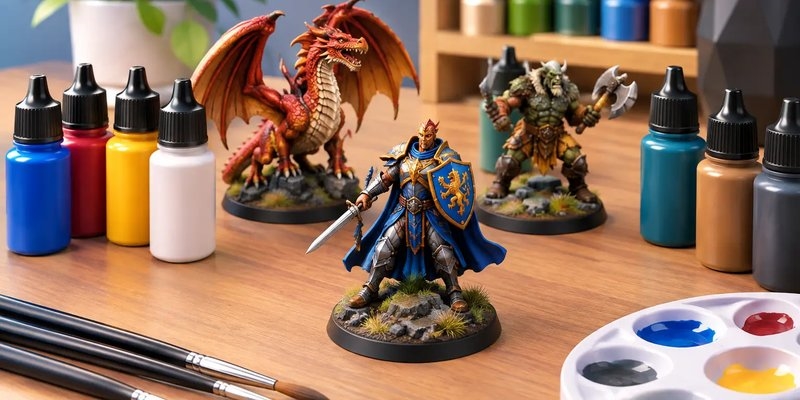
Vallejo Miniature Paints for Better Tabletop Minis
A good miniature can look flat or fantastic before a brush has touched it. The difference is often paint choice, not artistic talent. Vallejo miniature paints have earned a permanent place on hobby desks because the range gives new painters an approachable starting point and experienced painters enough control for display-quality work.
Whether you are preparing a Warhammer army, finishing a Dungeons & Dragons character, painting a Marvel Crisis Protocol team or bringing a 3D-printed miniature to life, Vallejo offers paints designed around different jobs. Choosing the right bottle first saves frustration later.
Why Vallejo miniature paints suit tabletop hobbyists
Vallejo paints are water-based acrylics supplied in practical dropper bottles. That matters more than it sounds. A dropper bottle makes it easy to put a controlled amount of paint on a wet palette, mix a repeatable colour, or thin only what you need. It also reduces the dried-paint build-up that can happen around open paint pots.
For tabletop painters, the biggest appeal is consistency. Vallejo colours generally go on smoothly when thinned correctly, dry with a low sheen in most ranges, and layer well over a prepared primer. Their pigments are strong enough to give dependable coverage without forcing you into a single thick coat that buries sculpted detail.
That does not mean every Vallejo paint behaves identically. Some colours, especially bright yellows, whites, reds and certain fluorescent shades, naturally need more patience. This is normal across miniature paint brands. Two or three thin coats will nearly always look cleaner than one heavy coat, regardless of the label.
Which Vallejo paint range should you choose?
Model Colour for classic brush painting
Model Colour is the range many hobbyists picture first. It has a broad selection of military-inspired, natural and character-friendly tones, including plenty of useful browns, greens, greys, skin colours and muted blues. If you paint historical models, realistic terrain, grimdark armies, tanks or weathered fantasy adventurers, Model Colour is an excellent foundation.
The range has a fairly matte finish and rewards painters who thin their paint slightly and build colour in layers. It is particularly useful when you want subtle variation rather than a bright, toy-like finish. A leather belt can start with a dark brown, gain a mid-brown highlight, then receive a small edge highlight in tan without looking overly glossy.
Game Colour for bold armies and characters
Game Colour is built with fantasy and science-fiction miniatures in mind. The palette is more saturated, with strong blues, greens, purples, reds and colours suited to armour panels, magical effects, alien skin and eye-catching faction schemes.
For a beginner painting a first Warhammer Combat Patrol or a squad for a skirmish game, Game Colour can make colour selection more straightforward. You can build a lively tabletop scheme quickly, then use washes, highlights and basing to add depth. Current Game Colour formulas are designed for smooth brush application, but paint is still paint: shake the bottle thoroughly, use a palette and avoid trying to cover black primer with a pale yellow in one pass.
Xpress Colour when speed matters
Xpress Colour is Vallejo's speed-paint style range. Applied over a light primer, it settles darker in recesses and lighter on raised areas, creating shading and base colour in a single stage. It is a smart option for a large horde army, board game miniatures, RPG monsters or a project you want on the table this month rather than next year.
The trade-off is control. Xpress Colour can pool if applied too heavily, and large flat armour panels may show patchiness if you repeatedly brush over paint as it begins to dry. Work one section at a time, keep the coat even, and let it dry before judging the result. Adding a conventional highlight afterwards often lifts the model from quick tabletop standard to something far more deliberate.
Metal Colour and metallic paints
Metallics are where it pays to match the product to the project. Vallejo's dedicated Metal Colour range is popular for airbrushing and can also provide exceptionally convincing metallic finishes by brush, especially for steel, aluminium and other realistic metals. Standard Vallejo metallics are often the simpler choice for everyday weapons, trim and armour details.
For a silver sword, a dark metallic base followed by a brighter metallic highlight gives more depth than one uniform silver coat. For gold, start with a warmer brown or bronze metallic, then pick out the sharpest edges with a lighter gold. A wash can shade the metal, but use it with restraint if you want it to retain its shine.
A practical Vallejo starting set
You do not need every colour in the rack to paint a convincing army. Start with the main colours in your chosen scheme, then add the practical paints that make them work: a dark neutral, a light neutral, a brown, a metallic if needed, and a wash or shading product.
For many projects, black, off-white, a dark brown, a bone or beige, silver, gold, red, blue and green cover a surprising amount of ground. Off-white is often more useful than pure white for highlights because it looks softer and covers more easily. A dark brown can shade leather, wood, fur, gold and even red armour without making every recess look pitch black.
If you are beginning from scratch, select paints for one unit or character instead of buying around the entire colour wheel. Finish that first project, notice which colours you actually reach for, and expand from there. It is a more cost-effective approach than collecting dozens of bottles that do not suit your current force.
How to get clean results with Vallejo
Preparation does much of the hard work. Wash resin or 3D-printed miniatures if they have residue, remove mould lines, and use a primer suited to the finish you want. White or light grey primer helps bright colours and Xpress Colour shine. Black primer makes metallics, dark armour and deep shadows easy, though pale colours will take extra coats. A zenithal prime, with black below and white or grey from above, is especially useful under translucent speed-paint formulas.
Put a small amount of Vallejo paint on a wet palette and add a little water if it feels thick. The goal is paint that flows from the brush without flooding details. Test it on the miniature's base or a spare piece of plastic. If it leaves a chalky, uneven coat, it may be too dry. If it runs into every recess, it is too thin or your brush is overloaded.
Use the side of the brush for broad areas and the tip for details. Rinse regularly, reshape the point, and do not let paint dry in the bristles. Quality brushes help, but good habits matter more than expensive gear. A reliable size 1 or 2 round brush handles much of a standard miniature, with a smaller brush reserved for eyes, buckles and tiny markings.
For highlights, keep the change in colour deliberate. Paint the base colour first, add a slightly lighter layer on raised areas, then place a final lighter colour only on the sharpest edges or highest points. This sequence works on Space Marine plates, cloaks, dragon scales and dungeon furniture alike.
Common problems and quick fixes
If paint keeps separating in the bottle, shake it longer. Vallejo bottles benefit from a proper shake, particularly metallics and older paints. A paint agitator can help, but never assume a few seconds is enough after a bottle has been sitting still.
If your layers look lumpy, the cause is usually paint that is too thick or a previous layer that was not dry. Let each coat settle before returning to it. Trying to fix a damp patch by brushing it again is one of the fastest ways to leave texture on a smooth cloak or armour panel.
If a wash stains the whole model instead of settling into recesses, remove some from the brush before applying it. You can also guide excess wash away from flat surfaces with a clean, slightly damp brush. For controlled shading, apply the wash only where shadows should sit rather than covering every panel by default.
Make the paint range work for your project
Vallejo is not a single painting method. Model Colour suits careful layering and realistic palettes. Game Colour brings strong, readable colour to gaming armies. Xpress Colour makes speed and volume achievable. Metallic ranges add convincing weapons and armour when you want more than flat grey paint.
The best range depends on the miniature, the time you have and the finish you enjoy. A tournament army may need a reliable fast workflow; a favourite commander or RPG hero can justify slower blends and extra highlights. At CardTastic, that is the hobby goal worth keeping in sight: choose paints that help you finish models you are proud to put on the table, then make time to actually play with them.