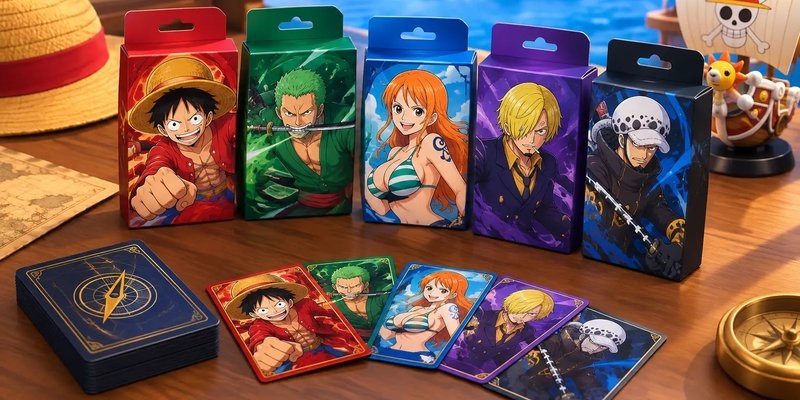
Which One Piece Card Game Starter Deck to Buy
A fresh booster pack is exciting, but it is not the easiest way to learn One Piece Card Game. A One Piece Card Game starter deck gives you a playable 50-card deck, a Leader, and the DON!! cards needed to get straight into a game. For new players, it removes the guesswork. For collectors returning to the game, it can also be a focused way to pick up a favourite crew, character or Leader.
The best deck is not always the newest release or the one winning the most tournament matches. It is the deck whose Leader, colours and game plan make you want to shuffle up for another round. Here is how to choose well, protect your cards properly, and take the first sensible steps towards upgrades.
What a starter deck gives you
One Piece Card Game starter decks are built around a Leader card. The Leader determines your deck's colour or colours, sets your available life total, and often has an effect that defines how the deck plays. Your 50-card main deck supports that Leader with Characters, Events and Stages, while the separate 10-card DON!! deck supplies the resource you use each turn.
That structure matters because One Piece is not simply about putting your strongest Character into play. You must choose whether to spend DON!! developing your board, holding it for a defensive Counter, powering up a Leader attack, or paying for an Event at exactly the right moment. A starter deck teaches that rhythm far better than a pile of assorted cards.
Contents can differ between releases, so always check the specific product listing or packaging. Some decks include a play sheet, while others may include bonus packs, alternate treatments or other release-specific extras. The core value, however, is a ready-to-play deck with a clear theme.
Choosing a One Piece Card Game starter deck by play style
Every colour has its own identity, though individual Leaders can bend those expectations. Start with the type of game you enjoy rather than trying to predict the next competitive format.
Red: fast pressure and decisive attacks
Red decks generally reward proactive play. They can apply pressure early, use efficient attacks, and often work well for players who like forcing difficult defensive decisions. If your favourite One Piece moments involve a crew charging forward and putting the opponent on the back foot, red is a natural place to start.
The trade-off is that aggressive decks need careful DON!! management. Throwing every card onto the field can leave you short on Counter power when the opponent strikes back.
Green: board control and smart timing
Green often interacts with rested Characters and rewards players who enjoy controlling combat. These decks can make an opponent think twice before leaving key cards vulnerable. They suit players who like creating an advantage through sequencing, rather than winning every exchange through raw power.
Green can be less forgiving when you commit the wrong Character or attack in the wrong order. It is satisfying for tactical players, but it pays to practise a few games before judging the deck's strength.
Blue: hand advantage and flexible answers
Blue decks commonly focus on card flow, returning cards to hand or deck, and using flexible Events. They appeal to players who enjoy having options and finding the right answer at the right time.
This style can feel technical at first. A blue deck may not always look as imposing on the board, but the ability to recycle resources or disrupt an opposing plan can win long games.
Purple, black and yellow: power, removal and life management
Purple frequently plays with DON!! in unusual ways, trading future resources for explosive turns or powerful effects. Black often centres on cost reduction and removal, making it a strong fit for players who want to systematically clear threats. Yellow interacts with life cards and triggers, producing games with big momentum swings.
These colours can be brilliant starter choices if the Leader appeals to you, but they each ask you to understand a particular mechanic. Purple players must plan around DON!! totals, black players need to read costs closely, and yellow players need to make calm decisions when their life is under pressure. There is no problem starting here - just expect a slightly steeper learning curve than a straightforward red or green strategy.
Multi-colour Leaders add even more deck-building possibilities. They can be exciting once you understand the basics, although they may be better as a second deck if you want the clearest first-game experience.
Look at the Leader before the character list
Starter decks are labelled with an ST product code, but the number alone should not decide your purchase. One release may be ideal for a favourite character yet use an older play pattern; another may contain cards that are especially useful as upgrades for an existing deck. Availability also changes, particularly for popular decks and limited reprints.
Read the Leader's text slowly. Ask three practical questions: does the effect make sense to you, do you enjoy the character or crew it represents, and can you picture using that effect every turn? A Leader is always available in the Leader area, so its ability matters more to your experience than any single card buried in the main deck.
For example, a Leader that rewards attacking may suit a player who wants direct action each turn. A Leader that filters cards, manipulates life, or rewards a particular trait can offer a deeper puzzle. Neither is automatically better. The right choice depends on whether you want quick, punchy games or a more methodical plan.
If you are buying for a younger player or for casual family games, a single-colour deck with clear card text is usually the friendliest choice. If you are buying for an experienced TCG player, a more technical Leader can be a great project from game one.
The small extras that make first games better
A deck can be played out of the box, but a few basics make a noticeable difference. Standard-size card sleeves protect the deck from marks, scuffs and sticky gaming tables. Use opaque sleeves for the main deck so no card can be identified from the back, and consider a separate sleeve colour for DON!! cards if you prefer a tidy play area.
A deck box keeps your cards together between games, while a playmat makes it much easier to keep the Leader, life cards, Character area and DON!! in the right places. Dice or small counters are useful for tracking effects, though they are not a replacement for communicating clearly with your opponent.
Two players need two decks. One starter deck is a complete deck for one person, not a two-player game in a box. For a first match, two decks with noticeably different play styles often make learning more enjoyable than two near-identical lists.
Play the deck before spending on upgrades
It is tempting to buy boosters immediately, especially when a new set is on the shelf. Boosters are great for collecting, trading and the thrill of opening packs, but they are not the most efficient way to fix a specific deck weakness. Play several games first and notice what actually happens.
Maybe your hand empties too quickly. Maybe you struggle to remove large Characters, defend your life, or find the cards your strategy needs. Those observations give you a useful upgrade plan. Singles can then target the cards that solve the problem, while booster packs remain a fun way to build your collection.
When you begin changing the list, remember the core construction rules: your main deck contains exactly 50 cards, you can normally include up to four copies of the same card number, and every card must match a colour on your Leader. Some Leaders and card effects also reward particular traits, crews or character names, so a powerful card is not necessarily the right card for your deck.
A sensible first upgrade is often consistency rather than glamour. Adding extra copies of a card you are happy to see early can improve a deck more than adding one expensive late-game card. Competitive builds can become costly, particularly when sought-after staples or alternate-art versions are involved, but a local-game-ready deck does not need to be finished overnight.
Playing, collecting and keeping expectations realistic
Starter decks sit at a useful intersection of play and collecting. They offer a themed entry point, often feature recognisable characters, and give you cards that can remain relevant in casual decks long after the original list has been changed. Sealed decks may also interest collectors, particularly around popular characters or older releases.
That said, sealed value is never guaranteed. Buy a second copy to keep sealed only if you genuinely enjoy having it in the collection. Buy the first copy to play. Cards are more memorable when they have survived a tense final turn, a clever counterattack, or a close game with mates.
For organised play, check the current format and event details before building towards a tournament. Card legality, restrictions and the competitive metagame can change over time. A starter deck is an excellent beginning, but it may need targeted upgrades to compete with refined tournament lists.
A better first session starts with simple games
For your first few matches, focus on the turn structure and combat choices rather than every possible card interaction. Announce attacks clearly, ask before rushing through an unfamiliar effect, and check card wording together when something feels unclear. Most rules questions become easier once both players slow down and identify what is active, rested, in hand and in life.
Bring the deck you are excited to play, sleeve it up, and give it a few honest games before changing anything. At CardTastic, that is the kind of table experience we love seeing: new players learning the ropes, collectors putting favourite characters to work, and opponents leaving with a rematch already planned.