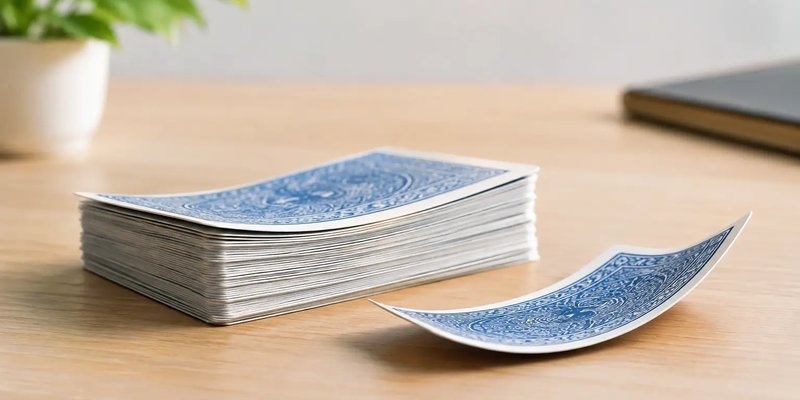
Why Do Cards Curl? Causes and Safe Fixes
A freshly pulled foil that starts bowing before it has even made it into a deck box is frustrating, especially when it is a chase card or a tournament staple. So, why do cards curl? In most cases, the answer is moisture. Trading cards are built from multiple layers of paper stock, ink, coatings and, for foils, a metallic layer. Those materials react differently when the air around them becomes too damp or too dry.
A little curve does not automatically mean a card is fake, damaged beyond saving or poorly printed. It does mean its storage environment needs attention. The good news is that most mild curling can be managed safely with patience and the right protection.
Why do cards curl in the first place?
Card stock is largely made from paper fibres. Paper naturally absorbs and releases moisture from the air, changing very slightly as it does. A standard non-foil trading card has layers that tend to move together reasonably well. A foil card is less forgiving because its foil layer resists moisture while the paper layers beneath it still react.
When one side of a card expands more than the other, the card bends. Think of it like timber that warps after being left in changing weather: the materials are still sound, but they are no longer sitting under equal pressure.
Humidity is the usual culprit in Australian collections. A run of wet weather, a humid summer, a room with poor ventilation or a collection stored near a bathroom can all raise the moisture content in card stock. Foils often develop the familiar upward curve in humid conditions, where the face of the card appears to curl inward and the edges lift.
Very dry air can cause the opposite problem. In air-conditioned rooms, heated rooms or particularly dry climates, the paper layer can lose moisture and shrink relative to the foil. The direction of the curl can reverse. That is why one collector may swear their foils curl in summer while another sees it happen during winter.
Heat adds another layer of risk. It can speed up moisture changes and can soften or stress coatings, adhesives and printed surfaces. Direct sunlight is particularly rough on cards because it combines heat with fading UV exposure. A card left on a windowsill or in a hot car can end up curled, faded and difficult to restore.
Foils curl more, but they are not the only cards affected
Pokémon, Magic: The Gathering, Disney Lorcana, Yu-Gi-Oh!, One Piece and Flesh & Blood all use different card stocks, printing methods and foil treatments across sets and regions. Some finishes are more prone to visible curling than others. Etched foils, textured cards, premium treatments and thicker showcase-style cards can react differently even within the same release.
Non-foil cards can curl too. If a whole deck has a gentle bend, or cards at the top of a binder page have changed shape, the issue may be the room rather than the finish. Double-faced cards, laminated cards and cards with heavier ink coverage can also show movement when humidity changes quickly.
It is worth separating curling from other forms of damage. A card with a smooth, even bow may be responding to the environment. A card with a sharp crease, rippled surface, peeling layer, water staining or a raised edge has suffered physical or water damage. Flattening methods that may help a mild curl will not repair those problems and can make them worse.
The safest way to flatten curled cards
The best approach is gradual reconditioning, not force. Avoid hair dryers, irons, microwaves, ovens, fridges, freezers and direct sun. These shortcuts can warp the card further, damage its finish or create surface issues that are far more noticeable than the original curl.
Start by moving the cards into a stable indoor environment. For most trading card collections, moderate relative humidity is the goal - roughly 40 to 55 per cent is a practical range. The exact sweet spot varies by card and local conditions, but consistency matters more than chasing a perfect number.
Place each card in a clean, correctly sized sleeve. For valuable singles, a fitted inner sleeve followed by a quality outer sleeve provides useful support without squeezing the card. Put the sleeved card into a semi-rigid holder, top loader or binder with firm, archival-safe pages. For a playset or deck, a well-fitted deck box can help cards settle once the humidity is stable.
For mild curls, laying sleeved cards flat inside a rigid storage box, with even and modest weight on top, can assist. Use a clean book or another flat, smooth object, not a stack of random household items. Keep the cards protected and check them every day or two. The aim is gentle support while the card stock acclimatises, not crushing it into shape overnight.
Give the process time. A card exposed to changing humidity for weeks will not necessarily settle in an afternoon. Depending on the severity and the environment, it may take several days or a couple of weeks. If it begins to flatten, keep it in stable storage rather than immediately moving it back to the spot where it curled.
Managing humidity without overcorrecting
Collectors in humid parts of Australia often reach for silica gel straight away. Desiccant packs can help in a properly sealed storage container, but they are not a universal fix. Too much desiccant in a small container may make conditions overly dry, which can simply flip the direction of the curl.
Use humidity-control products conservatively and keep them separate from the cards. Never place loose desiccant directly against card surfaces. A small digital hygrometer in your storage area is more useful than guessing, particularly if you have higher-value binders, graded cards, sealed product or a large foil collection.
If the room stays damp, a dehumidifier may be the more reliable option. If the room becomes very dry due to heating or air conditioning, reducing that airflow around the collection or using a humidity-controlled storage solution may be enough. The trade-off is simple: sealing cards away from every environmental change can be helpful, but completely airtight storage without monitoring can trap an unsuitable condition inside.
Avoid storing cards in garages, sheds, roof spaces, laundries and near external walls where temperature shifts can be dramatic. A cupboard in a climate-stable living area is usually a better choice. Keep binders and boxes off the floor as well, especially where a leak, damp carpet or summer storm could put the collection at risk.
Storage choices that prevent future curling
A good sleeve does more than prevent scratches. It creates a small buffer against handling and rapid moisture changes. For cards played regularly, use opaque-backed sleeves that are all the same size and condition. Apart from protecting the cards, this helps prevent curled foils from becoming identifiable in a deck during sanctioned play.
For collection pieces, inner sleeves and rigid holders are ideal for individual cards, while side-loading binders with quality pages offer strong support for sets and trade binders. Do not overfill a binder. Tight pages can put pressure on corners and edges, while loose or cheap pages may allow cards to shift and bow.
Sealed booster boxes and products deserve the same care. Keep them out of direct light and away from humidity swings. The shrink wrap is not a climate-control system, and sealed product can still suffer from warped packaging, softened glue or moisture-related issues.
When transporting cards to Commander night, a Pokémon League event or a weekend tournament, do not leave your deck box in the car. Even a short stop can turn a parked vehicle into a hotbox. Carry cards in a backpack or bag with a little insulation from the weather, then bring them indoors promptly.
When curling matters for play and value
A mildly curled card is often still perfectly collectable, but condition-sensitive buyers, graders and competitive organisers may view it differently. For high-value singles, disclose noticeable curling when trading or selling. Clear condition conversations are part of looking after the community as much as looking after the card.
In competitive play, a curled foil can potentially be treated as a marked card if it is distinguishable from the rest of the deck. This depends on how obvious the difference is, the event rules and the judge’s assessment. If your foil lands, staples or favourite commander are noticeably bowed, use matching foils where practical, replace them with non-foils, or ensure the entire deck is sleeved consistently and lies as evenly as possible.
For cards you intend to grade, resist aggressive flattening. Grading evaluates more than corners and centring. Surface impressions, altered texture and pressure marks can hurt the result. Stable storage and a conservative approach are safer than trying to force a card perfectly flat.
A curled card is usually your collection telling you something about its environment. Give it consistent conditions, proper sleeves and time to settle, and most cards will have every chance of looking right at home in a binder, deck box or display case.