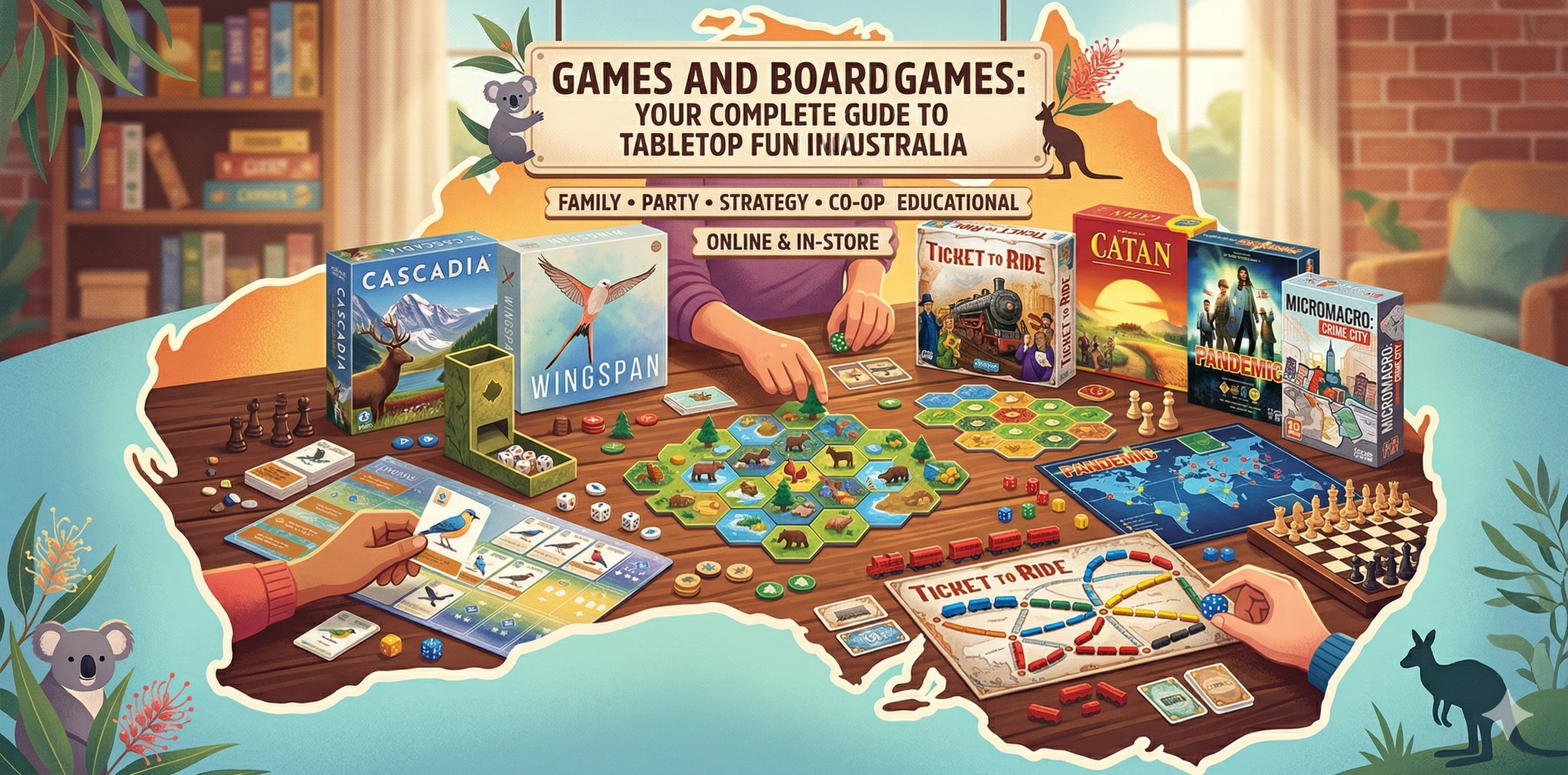
Games and Board Games: Your Complete Guide to Tabletop Fun in Australi
Key Takeaways
-
Games and board games covers everything from classic titles like Monopoly and Chess to modern hits such as Catan, Cascadia, and MicroMacro: Crime City, available both online and in store across Australia.
-
Readers can quickly choose between family, party, strategy, co-operative, and educational board games, with concrete examples for each category.
-
Shopping online gives access to wide ranges, competitive prices, and frequent discounts, while physical showrooms offer hands-on browsing and expert advice. Board games are available both online and instore at retailers.
-
Board games deliver social and educational benefits: improving communication, problem-solving, and maths skills for kids and adults alike.
-
The article finishes with an FAQ answering practical questions about age ranges, storage, care, and how to enter the hobby on a budget.
Introduction to Games and Board Games
Between 2020 and 2025, the world experienced a global board game boom that reshaped how households spend their free time. This boom shaped entertainment habits, making board games a central part of family and social gatherings. Australian retailers reported a 40% increase in tabletop gaming sales during this period, as families sought screen-free entertainment and unplugged bonding. Today, boardgames remain a staple in homes from city apartments to regional towns.
When we talk about board games, we mean far more than Monopoly and the roll-and-move classics you might remember from childhood. Modern tabletop games include eurogames like Catan, family titles such as Ticket to Ride, party games like Wavelength, co-operative experiences including Pandemic, and educational games like Mobi. Chess, Scrabble, and Guess Who still hold their place on the shelf, but they share space with hundreds of innovative designs released each year. Board games are more fun than they used to be.
This guide will walk you through the types of games available, how to choose the right one for your team, where to buy in Australia, and how to build a collection that suits every occasion.
-
Scope covered: Family, party, strategy, co-op, educational, and two-player games
-
Buying options: Online retailers and in store visits
-
Practical advice: Selection criteria, care tips, and collection building
Types of Board Games and Who They Suit
Different groups need different experiences. A family with young kids wants something cooperative and quick, while adult hobbyists might love a 90-minute strategy session. Party hosts need games that scale to ten players and generate laughter. Understanding these categories helps you find exactly what fits.
Family Games work beautifully for mixed ages and 30 to 60 minute sessions. Family games are designed to be enjoyed by players of all ages and often focus on fun and interaction. Titles like Outfoxed, Cascadia, and Ticket to Ride let grandparents play alongside kids without complex rules. These games balance fun with just enough strategy to keep adults engaged while remaining accessible to younger players.
Party Games prioritise laughter, larger player counts, and easy rules. Party games are typically designed for larger groups and emphasize social interaction and entertainment over competition. Wavelength and Hues & Cues challenge groups to read each other’s minds through word and colour associations. Articulate delivers rapid-fire word descriptions, while Codenames is a word-deduction game for 4-8+ players that encourages creative thinking and high-stakes tension. Exploding Kittens offers quick card game chaos for up to five players.
Strategy and Hobby Games reward planning and repeated play. Strategy games require players to use tactics and planning to achieve victory, often involving resource management or complex decision-making. Catan introduced millions to resource trading and negotiation. Azul is a tile-placement strategy game that is simple to learn but offers deep strategy. Pandemic puts your team against global disease outbreaks. MicroMacro Crime City offers Where’s Wally-style crime solving on a massive illustrated map, where you work together solving each case. Wingspan lets you build bird sanctuaries through engine-building mechanics.
Co-operative Games unite players against the game itself. Cooperative games like Pandemic and Forbidden Island focus on teamwork and collective strategy. In Pandemic, you win or lose together. 5 Minute Dungeon creates frantic real-time card-slaying where communication is everything. Outfoxed eliminates sibling rivalry by making victory a shared experience.
Educational Games embed learning into play. Mobi drills maths operations through racing card mechanics. Genius Star develops spatial reasoning. Logic puzzles in various kits build problem-solving skills without feeling like homework.
Two-Player and Quick Games suit couples, travel, or coffee-table play. Klask delivers magnetic dexterity duels in 10 minutes. Jaipur offers set-collection trading for two. Pass the Pigs provides probability fun in under 15 minutes. Tammy is a simple, fast-paced game involving quick thinking in specific categories, typically played under a time constraint.
-
Family: Outfoxed, Cascadia, Ticket to Ride (2–6 players, ages 6+)
-
Party: Wavelength, Hues & Cues, Articulate (4–12+ players)
-
Strategy: Catan, Pandemic, MicroMacro, Wingspan (2–5 players, 60–120 min)
-
Co-op: 5 Minute Dungeon, Outfoxed (2–6 players)
-
Educational: Mobi, Genius Star (all ages)
-
Two-player: Klask, Jaipur, Pass the Pigs
How to Choose the Right Board Game
Choosing the right game comes down to matching playtime, age, complexity, and theme to your group. Think of selecting games and board games as a step-by-step journey—each step brings you closer to the perfect fit for your group. A mismatch here leads to bored players or frustrated kids, so take a moment to check these factors before you buy.
Player count shapes your options dramatically. Cascadia plays 1 to 4, making it perfect for smaller gatherings. Wavelength scales to teams of 10 or more for parties. 5 Minute Dungeon works for 2 to 5. Always verify the box displays the right range for your typical group.
Age and complexity matter for everyone’s enjoyment. Games marked 4+ like Outfoxed use simple iconography perfect for young kids. Mobi suits primary school ages with its number focus. Catan and Pandemic work well for teens and adults at the 12+ level. Heavier euros target 14+ players who love deep strategy.
Playtime varies widely. Pass the Pigs finishes in under 15 minutes—ideal as a filler between activities. Cascadia and Ticket to Ride run 30 to 45 minutes for comfortable family sessions. Strategy titles like Pandemic or Catan can extend to 90 minutes or beyond.
Theme and mood determine engagement. MicroMacro Crime City appeals to detective lovers. Cascadia offers serene nature-building. Articulate brings word-guessing energy. Hues & Cues explores colour perception. 5 Minute Dungeon delivers adrenaline-fueled race against time.
Replayability and expansions add long-term value. Catan and Pandemic offer expansion packs that double your scenarios. MicroMacro has 16+ cases with sequels available. Games with modular setups reward repeated play.
Quick selection checklist:
-
Confirm player count matches your group
-
Check age rating and complexity level
-
Set target playtime before shopping
-
Match theme to group interests
-
Consider expansion potential for value
There are many quality board games available at just a moment's notice.
Popular Modern Board Games to Know in 2026
Beyond the classics, certain modern titles have become staples on Australian tables between 2019 and 2026. These games consistently appear on recommendation lists and store shelves. Popular modern games include The Jackbox Party Pack, which is a hit at parties and uses smartphones as controllers for interactive gameplay; Deep Rock Galactic, a cooperative shooter featuring space dwarves that requires teamwork to navigate destructible environments; Fortnite, which allows friends to interact in a virtual world with both competition and collaboration; It Takes Two, a narrative adventure that requires two players to work together; Doodle Dash, a fast-paced drawing game for 4-7 players where guessers watch artists draw with closed eyes; Art Society, a strategic game where players bid on and arrange art collections, combining visual elements with competitive strategy; and Among Us, a social deduction game for 4-15 players where players identify impostors.
Cascadia invites players to build Pacific Northwest habitats using tile-laying and animal placement. Easy to learn but surprisingly strategic, it appeals to families and serious gamers alike. The game received a 2021 Kennerspiel des Jahres nomination and remains a bestseller. Cascadia is a tile-laying game that involves building ecosystems and is noted for its beautiful art and high replayability.
MicroMacro Crime City won the 2021 Spiel des Jahres, Germany’s prestigious Game of the Year award. Players cooperatively trace suspect paths across a massive illustrated city map, solving crimes together without turns. It requires zero setup and suits couples through to larger groups.
5 Minute Dungeon throws players into frantic cooperative card play where you defeat dungeon bosses against a ticking clock. Communication and quick combos determine survival. Expansions add heroes and bosses for replayability.
Wavelength and Hues & Cues focus on reading each other’s minds. Wavelength uses a dial and abstract prompts to guess where concepts fall on a spectrum. Hues & Cues challenges players to describe colours using word clues. Both generate laughter and conversation.
Klask combines air-hockey energy with board game portability. Two players control magnetic pieces to score goals on a compact board shaped like a ball field, aiming to score at each end. It’s perfect for cafés, home game rooms, or anywhere you need quick competition.
Classic evergreens like Catan, Carcassonne, Ticket to Ride, and Pandemic continue dominating recommendation lists. Catan alone has sold over 30 million copies worldwide. Catan is a classic resource management game for 3-4 players where players build settlements. Pandemic is a fully cooperative game for 2-4 players focused on stopping diseases. Ticket to Ride is a modern classic where players collect train cards to claim railway routes across a map.
-
Cascadia: Families and strategy lovers (1–4 players)
-
MicroMacro: Couples, families, puzzle fans (1–4 players)
-
5 Minute Dungeon: High-energy groups (2–5 players)
-
Wavelength/Hues & Cues: Party hosts (4–12+ players)
-
Klask: Two-player duels and non-gamers
Buying Games and Board Games Online vs In-Store
Australian players now commonly mix online shopping with visits to local board game stores like Good Games, each offering different benefits. Understanding both options helps you discover the perfect products for your home.
Online benefits include access to thousands of SKUs across hundreds of categories. For example, Games Empire stocks over 7221 products across 410 categories of board games, provides regular sales and offers, and ensures careful packaging and delivery so your board games arrive in excellent condition. Good Games offers fast delivery and secure payment options for online board game purchases. Mr Toys provides a vast range of board games, including classic and new titles, available for online purchase. Games World offers discounts on various board games, with some items marked down from their original prices. JB Hi-Fi offers board games on sale regularly. You can compare prices, read reviews, and often find discounts of 10 to 20 percent. When you buy board games online, retailers ship Australia-wide with careful packing to protect box corners and inserts. Most orders arrive within 2 to 7 days depending on location. Shopping on a retailer's website is convenient, allowing you to browse, check special offers, and access customer support all in one place.
In-store benefits let you pick up and inspect boxes before purchase, with many board games available instore for immediate purchase. Staff provide expert recommendations based on your group’s preferences and are known for being kind and helpful, ensuring a positive customer service experience. Many physical stores host demo nights and events where you can try before you buy. Walking into a store also means no waiting for delivery—you leave with your game in hand.
Price and authenticity favour trusted retailers. Counterfeit copies with poor card stock and colours exist in the market. Official retailers guarantee authentic components and proper translations. This matters especially for complex games where component quality affects play.
Delivery and returns follow standard Australian practice. Most retailers offer returns within 30 days for damaged items with photo evidence. Some provide free shipping on orders over a certain threshold, making online purchasing even more attractive.
Buying gifts requires extra attention. Check age range and theme fit before purchase. Verify whether the recipient already owns classics like Monopoly or Chess. The perfect gift matches the recipient’s interests and adds something new to their shelf.
-
Online: Wide stock, competitive prices, home delivery
-
In-store: Hands-on browsing, staff advice, immediate access
Building and Caring for a Board Game Collection
Many Australian households now own multiple titles, transforming a few family games into a curated collection over time. Building wisely ensures every game gets played.
Starting a collection works best with variety. Begin with one classic like Scrabble or Chess, one family strategy game such as Cascadia or Catan, and one party title like Wavelength or Articulate. This covers most occasions without cluttering your shelf.
Rotating and culling keeps collections fresh. Track which games get played using apps or simple notes. Donate or sell unused titles to make room for new discoveries. Hobbyist surveys suggest around 30% of owned games go unplayed—be honest about what your group actually enjoys.
Storage and protection extends game life. Store boxes vertically on shelves to prevent warping. Use zip-lock bags or small containers inside boxes to organise tokens and cards. Australian homes can experience humidity and heat, so keep games in climate-controlled spaces away from direct sunlight.
Component care prevents common damage. Sleeve heavily shuffled card decks with standard card sleeves. Tape minor box splits before they worsen. Label small piece bags clearly—especially important in households with pets or young kids who might lose a critical token.
Collection best practices:
-
Start with 3–5 versatile titles covering different occasions
-
Track plays and remove unused games annually
-
Store vertically in stable, cool conditions
-
Sleeve cards and bag small components
-
Learn rules from official sources before teaching others
Game Communities in Australia
Australia’s board game scene is more vibrant than ever, with communities of passionate players gathering both online and in person to share their love of tabletop fun. Whether you’re looking to join a weekly game night, find the perfect gift for a family member, or simply discover the latest releases, there’s a welcoming space for everyone.
For those who prefer to buy board games online, Australia offers a wealth of secure websites and specialist stores. When shopping online, it’s important to choose a site that has performed proper security verification to protect your personal information and keep malicious bots at bay. Look for a security service that verifies the site owner and displays a verification successful message or a unique ray ID—these steps help ensure your shopping experience is safe and your data is protected. Many online stores offer a huge range of board games, card games, and even tabletop kits and paint sets, making it easy to find exactly what you need from the comfort of your home.
In-store experiences remain a cornerstone of the Australian board game community. Good games stores across the country invite players to browse shelves stocked with classics like Monopoly and Trivial Pursuit, as well as the latest strategy and family games. Many stores host regular events, tournaments, and demo nights, giving you the chance to play, learn, and connect with fellow enthusiasts. These gatherings are perfect for families, friends, and kids looking to join the fun, and they often provide expert advice to help you pick the right game for your group.
Board games make a perfect gift for kids and adults alike, encouraging creativity, teamwork, and laughter. Many stores offer special deals, price match guarantees, and seasonal offers—so it’s always worth checking prices and waiting for the right moment to buy. Whether you’re shopping online or in store, you’ll find a wide selection of games, accessories, and even paint kits to enhance your tabletop adventures.
No matter your age or experience level, Australia’s board game communities invite you to join in, visit your local store, or explore online. Discover new games, meet new friends, and enjoy the endless fun that board games bring to every table.
Benefits of Playing Games and Board Games
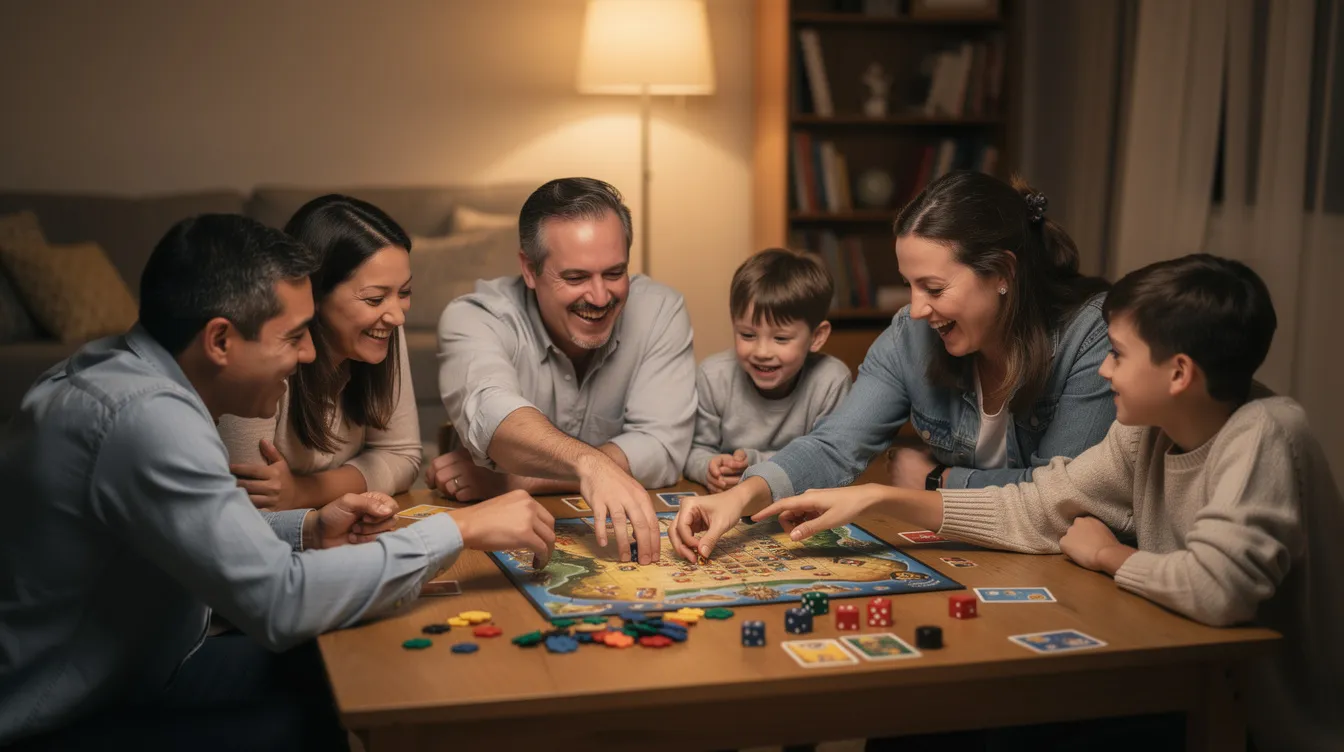
Family and hobby gaming communities grew substantially during and after the COVID-19 lockdown years. The benefits that drew people to tabletop games persist today.
Family bonding happens naturally during game nights. Titles like Outfoxed, Guess Who, and Ticket to Ride create shared stories and happy memories. Regular play establishes unplugged time together that competes with screens and individual devices.
Cognitive skills develop through strategic play. Cascadia, Genius Star, MicroMacro, and Chess build problem-solving, planning, and pattern recognition. Research from psychological studies suggests board games can enhance executive function in children by 20 to 30 percent through repeated play.
Communication and language improve with party and word games. Articulate, Wavelength, and Hues & Cues strengthen vocabulary and teach players to read subtle cues. These skills transfer to real-world social interactions.
Maths and logic for kids become fun rather than work. Mobi turns arithmetic into a racing game. Number-based games help children practice operations without the pressure of traditional drills.
Mental health and screen breaks matter in our digital age. Board games provide mindful, face-to-face alternatives to digital entertainment. They reduce screen fatigue and create space for genuine human connection.
-
Bonding: Creates shared family experiences
-
Cognition: Builds planning and problem-solving
-
Communication: Strengthens vocabulary and social reading
-
Education: Makes maths engaging for kids
-
Wellness: Provides mindful screen-free time
FAQ
What are good first board games for families with kids under 10?
Start with Outfoxed, Mobi, Hues & Cues (with adult guidance), and Ticket to Ride: First Journey. Classic Guess Who also works well. These titles have clear rules and finish in under an hour. Cooperative games like Outfoxed reduce conflict because everyone works together, which helps with younger children and siblings who might otherwise argue over competition.
How many games do I need to start a home collection?
Three to five games create a versatile starter library. Include one party game, one family strategy title, one quick filler, and optionally a two-player option and a co-op. A sample line-up might be Wavelength, Cascadia, Pass the Pigs, Klask, and 5 Minute Dungeon—this set covers parties, family nights, quick breaks, duels, and cooperative challenges.
Are modern board games very complicated compared to classics?
Many modern titles like Cascadia, MicroMacro Crime City, and 5 Minute Dungeon are designed to be approachable after a short rules explanation. Some hobby games do run heavier, but checking the box for complexity ratings and age guidelines helps. Start with games labelled 8+ or 10+ for an easier learning curve before stepping into heavier strategy.
How can I protect my games from damage when kids or guests are rough with components?
Use card sleeves for frequently shuffled decks and small containers or zip-lock bags for tokens. Designate a stable table away from food and drinks during play. Minor box wear is normal, but keeping boxes vertical on shelves and avoiding stacking heavy games on top helps them last for years.
Can board games be played solo if I don’t always have a group?
Many modern games include official solo modes. Puzzle titles like Genius Star work perfectly alone. Check product descriptions for “1+ players” when shopping. Some popular games also have community-made solo variants you can discover through hobbyist forums and websites. Solo play has grown significantly, with around 40% of new titles now offering single-player options.